Ecuador’s Cocoa at the EUDR Crossroads: The Real Challenge Is Not Only Deforestation, but Proof

Ecuador’s cocoa sector has the geography, market reputation and increasingly sophisticated supply chains to remain a major supplier to Europe. But a spatial assessment by MosaiX shows that the transition toward EUDR-ready cocoa will depend on something more fundamental: knowing exactly where cocoa comes from, what happened on that land before 2021, and whether the evidence can withstand scrutiny.

Ecuador is one of the world’s important cocoa origins, with production landscapes stretching across the humid lowlands of the Pacific coast and into parts of the country’s interior. A recent geospatial assessment identified roughly 3 million hectares of potential cocoa-planted area, equivalent to about 11.9% of Ecuador’s territory, with major concentrations in Manabí, Esmeraldas, Los Ríos, Morona Santiago, Santo Domingo de los Tsáchilas and Guayas.

That scale tells only part of the story.

As the European Union Deforestation Regulation reshapes expectations around cocoa sourcing, the central question is shifting from where cocoa is grown to whether every shipment can be connected to land whose history, legality and boundaries can be demonstrated.

The assessment suggests Ecuador has considerable potential to make that transition. But it also reveals several gaps that could become far more important than production volume itself.

A land-documentation gap hiding beneath the cocoa map

One of the most striking findings concerns land status.

According to the spatial comparison used in the assessment, around 2.8 million hectares, or approximately 92% of the mapped potential cocoa area, fall outside the registered land layer used in the analysis, while roughly 244,000 hectares, or 8%, appear as registered.

That figure needs to be interpreted carefully.

The report itself notes that the cocoa dataset represents potential planting areas as well as areas identified as cocoa, meaning it can overestimate actual planted hectares. It also warns that cadastral information can be incomplete in rural areas. The 92% figure should therefore not be read as proof that 92% of Ecuadorian cocoa farms are legally invalid or without legitimate tenure. It is better understood as a measure of the documentation and spatial-data gap that would need to be resolved during due diligence.

That distinction matters.

For EUDR implementation, a farm does not become compliant simply because its coordinates are known. Buyers need sufficiently reliable evidence connecting a commodity to its production plot, alongside evidence supporting deforestation-free status and compliance with applicable laws.

In other words, mapping is the beginning of due diligence, not the end of it.

The deforestation signal is relatively small—but it cannot be ignored

When the mapped cocoa plots were overlaid with post-2020 forest-loss information, the analysis identified 185 plots out of 212,572 assessed plots, covering approximately 65.4 hectares, that intersected areas recorded as deforested during 2021–2022.

Viewed against hundreds of thousands of plots, this is not evidence that Ecuadorian cocoa as a whole is driving widespread recent deforestation.

But from a regulatory perspective, percentages can be misleading.

EUDR due diligence operates much closer to the level of individual production plots and consignments. A relatively small number of problematic farms can therefore become significant when cocoa from those farms enters an otherwise compliant supply chain.

The implication is important: national-level deforestation statistics alone cannot determine whether a cocoa shipment is compliant.

The question eventually becomes much more specific:

Was this cocoa produced on this plot, and was that plot forest-free after the EUDR cutoff?

A rapidly changing forest-risk context

The broader forest landscape also deserves attention.

Using the European Commission Joint Research Centre’s Tropical Moist Forest dataset, the assessment found national forest loss increasing from approximately 4,913 hectares in 2021 to 12,232 hectares in 2022, falling slightly to around 11,013 hectares in 2023, then rising sharply to approximately 45,367 hectares in 2024.

The spatial pattern is equally important. Forest loss is not distributed uniformly across Ecuador. The report identifies Esmeraldas as the province with the highest cumulative deforestation among the provinces examined, suggesting that due diligence cannot rely on one uniform monitoring strategy across the country.

A cocoa plot in a stable agricultural landscape and another close to an active forest-conversion frontier may both need geolocation and documentation, but they do not necessarily require the same level of monitoring.

That points toward a more practical approach to EUDR implementation: risk-based verification rather than treating every cocoa farm identically.

Protected forests reveal a second kind of risk

Deforestation is only one part of the picture.

The assessment also compared cocoa plots against Ecuador’s mapped Permanent Forest Reserves. Around 2.19 million hectares are represented in the reserve dataset used by the study, and the overlay identified 184 cocoa plots covering approximately 527 hectares that intersect these reserve areas.

This finding illustrates an often-overlooked aspect of commodity compliance.

A plantation may show no recent forest clearance and still raise a due-diligence concern if it occupies land where agricultural production conflicts with applicable land-use restrictions.

For companies building EUDR systems, satellite deforestation monitoring is therefore not enough. Plot screening increasingly needs to combine several layers: land cover, forest-loss history, cadastral information, protected areas and other relevant legal boundaries.

The challenge becomes less about producing a single map and more about assembling an evidence stack around every production location.

What plot-level evidence looks like in practice

A case study from Agrícola del Litoral in Los Ríos Province offers a useful illustration.

Three parcels covering approximately 243.6 hectares were evaluated using cadastral information, protected-area data and satellite imagery. Planet imagery from September 2019 and May 2025 indicated that the parcels were already in agricultural use before the EUDR cutoff and remained agricultural afterwards. The nearest mapped forest reserve was approximately 27 kilometres away, with no overlap identified in the available dataset.

The significance of the example is not the individual farm.

It is the method.

Instead of asking a supplier simply to declare that its cocoa is deforestation-free, the process builds a reproducible file containing parcel boundaries, historical imagery, land-status information and protected-area screening.

That is much closer to what credible commodity due diligence increasingly requires: evidence that another analyst, buyer or auditor can reproduce.

From cocoa mapping to an evidence system

This is where many traceability programs encounter their real bottleneck.

Companies may already possess farmer lists, GPS points, certification records or sourcing contracts. But those datasets are often stored separately. Plot identifiers change between systems. Polygons may contain errors. Legal documents are held offline. Satellite assessments may not be linked back to specific suppliers or shipments.

The report proposes a workflow starting with a stable plot registry, followed by geolocation quality assurance, deforestation and reserve screening, legality documentation, risk classification, evidence archiving and continuous monitoring.

This represents an important shift in thinking.

Traceability should not simply answer “Who is the farmer?”

It should eventually answer:

Which plot produced the cocoa, what is the land history of that plot, what legal evidence supports production there, what risks were detected, what mitigation was undertaken, and which shipment contains the resulting cocoa?

Digital systems can make that process scalable. The report describes the use of integrated geolocation, automated forest-loss screening, protected-area and cadastral overlays, supply-chain connections and standardized reporting as components of an EUDR-oriented due-diligence architecture.

Technology, however, cannot fix unreliable source data by itself. The report explicitly notes that field mapping, farmer engagement and clear rules over data ownership and editing remain essential foundations.

The opportunity for Ecuador

Perhaps the most important conclusion from the assessment is that Ecuador’s cocoa challenge should not be framed simply as a deforestation problem.

The analysis does identify post-2020 forest-loss overlaps and cocoa plots intersecting protected forest areas. Those cases deserve investigation.

But the larger structural challenge is turning fragmented spatial, cadastral and supply-chain information into verifiable plot-level evidence.

That is also where the opportunity lies.

Ecuador already has national agricultural datasets, environmental information, a strong export-oriented cocoa sector and increasingly sophisticated private traceability initiatives. The next step is connecting these pieces.

For exporters and buyers, this means improving polygon quality, validating supplier locations, screening historical land-use change and building stronger links between farm data and physical cocoa flows.

For government agencies, it means improving interoperability among agricultural, cadastral and environmental datasets.

And for smallholders, it means ensuring that the transition toward stricter documentation does not simply exclude producers whose land tenure is legitimate but poorly represented in formal digital systems.

The report’s broader conclusion captures the moment well: Ecuador combines strong cocoa-market opportunities with remaining gaps around land tenure information and isolated instances of cocoa associated with recently cleared or protected land.

The future of EUDR-ready cocoa may therefore depend less on producing another sustainability declaration and more on something much more concrete:

building a chain of evidence—from the cocoa tree, to the plot, to the supplier, to the shipment.

And in an increasingly regulated commodity market, that evidence may become as valuable as the cocoa itself.
From RSPO Mill List Disclosure to EUDR Readiness: Closing a Transparency Gap in Europe’s Palm Oil Supply Chains

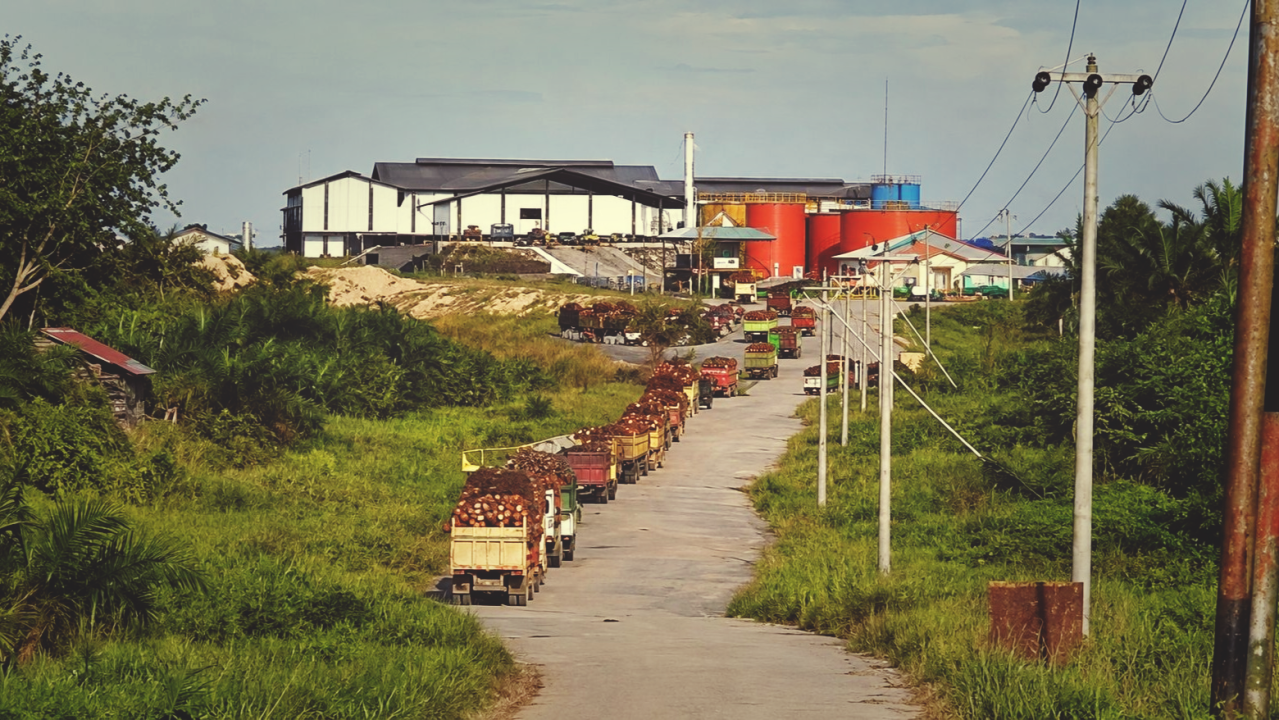
A palm oil mill can seem very far from a supermarket shelf in Europe. In reality, it is one of the most important links connecting tropical production landscapes with the companies, products and consumers at the other end of the global supply chain.

A bottle of shampoo in Amsterdam, a biscuit in Berlin, or an industrial ingredient arriving at the Port of Rotterdam may have traveled through a chain that began thousands of kilometers away, among oil palm plantations in Indonesia or Malaysia. Fresh fruit bunches are harvested and delivered to a palm oil mill, where they are processed into crude palm oil or palm kernel products. From there, the oil may pass through refiners, crushers, traders, ports, manufacturers, and distributors before appearing in food, cosmetics, oleochemicals, animal feed, household products, or energy markets. By the time it reaches Europe, its physical journey can be long, but its information trail can be even more complicated.

For more than two decades, the palm oil industry has been trying to make that journey more visible. One of the most influential efforts began in 2004 with the creation of the Roundtable on Sustainable Palm Oil, or RSPO, a global non-profit, voluntary membership organization founded by stakeholders including WWF, the Malaysian Palm Oil Association, Unilever, Migros, and AAK. Rather than representing a single part of the industry, RSPO brought growers, processors, and traders, consumer-goods manufacturers, retailers, financial institutions, and civil-society organizations around the same table. Its ambition was to build a global framework under which palm oil could be produced and traded while reducing environmental and social harm.

Over time, that ambition evolved into standards that reach far beyond a simple certification label. The RSPO Principles and Criteria address how plantations are developed and managed, how forests and areas of high conservation and carbon value are protected, how workers and local communities are treated, and how companies demonstrate responsible production. The current 2024 Principles and Criteria, now at Version 4.2, retain safeguards addressing deforestation and incorporate approaches such as High Conservation Value and High Carbon Stock assessments, alongside stronger attention to human-rights due diligence. RSPO has prohibited conversion of primary forests since its early standards and has applied broader no-deforestation requirements based on HCV and HCS approaches since November 2018.

Certification, however, is only one part of the sustainability architecture that has developed around palm oil. During the past decade, many companies have also adopted NDPE — No Deforestation, No Development on Peat, and No Exploitation — commitments. The concept is straightforward in words but demanding in practice. Forests should not be cleared for new commodity production; new plantations should not be established on peat; and workers, indigenous peoples, local communities, and smallholders should not be exploited. Implementing these commitments has required companies to understand not only who they buy from, but what is happening within their suppliers’ production landscapes. Tools such as HCV and HCS assessments, satellite monitoring, grievance systems, supplier engagement, and the NDPE Implementation Reporting Framework have emerged to translate corporate commitments into something that can be monitored across complex supply bases.

This is where a seemingly modest piece of information becomes surprisingly important: the mill list.

A palm oil mill sits at a strategic point in the supply chain. It receives fruit from plantations and smallholders across a surrounding sourcing area, then passes processed palm products onward to refineries and traders. Knowing which mills supply a company does not tell us everything about where its palm oil originated, but it provides a crucial first map of the upstream supply chain. Without that map, tracing thousands of tonnes of palm-derived products back toward plantations becomes far more difficult.

RSPO recognized this gap before today’s regulatory debate over deforestation traceability had fully emerged. At its 15th General Assembly in 2018, RSPO members adopted Resolution GA15-6b, establishing the expectation that supplying mill lists should be made publicly available. The requirement covers both RSPO-certified and non-certified supplying mills. RSPO later created the Mill List functionality within MyRSPO, allowing companies to submit a file or a public URL and making the information visible through their membership profiles. RSPO currently asks members to submit mill lists for each half-year reporting period.

Importantly, this expectation does not stop with companies that purchase crude palm oil directly from mills. RSPO’s guidance makes clear that transparency is also expected from downstream actors such as traders, manufacturers, and retailers. A company buying refined palm oil or a palm-derived ingredient may never have a commercial relationship with an individual mill, yet it is still expected to work through its suppliers to identify the mills behind the material it buys. RSPO guidance identifies information such as the mill name, country, GPS coordinates, and parent company as part of that transparency chain. Even Supply Chain Associates and companies purchasing relatively small volumes fall within the mill-list transparency expectation.

That makes the current picture in Europe striking.

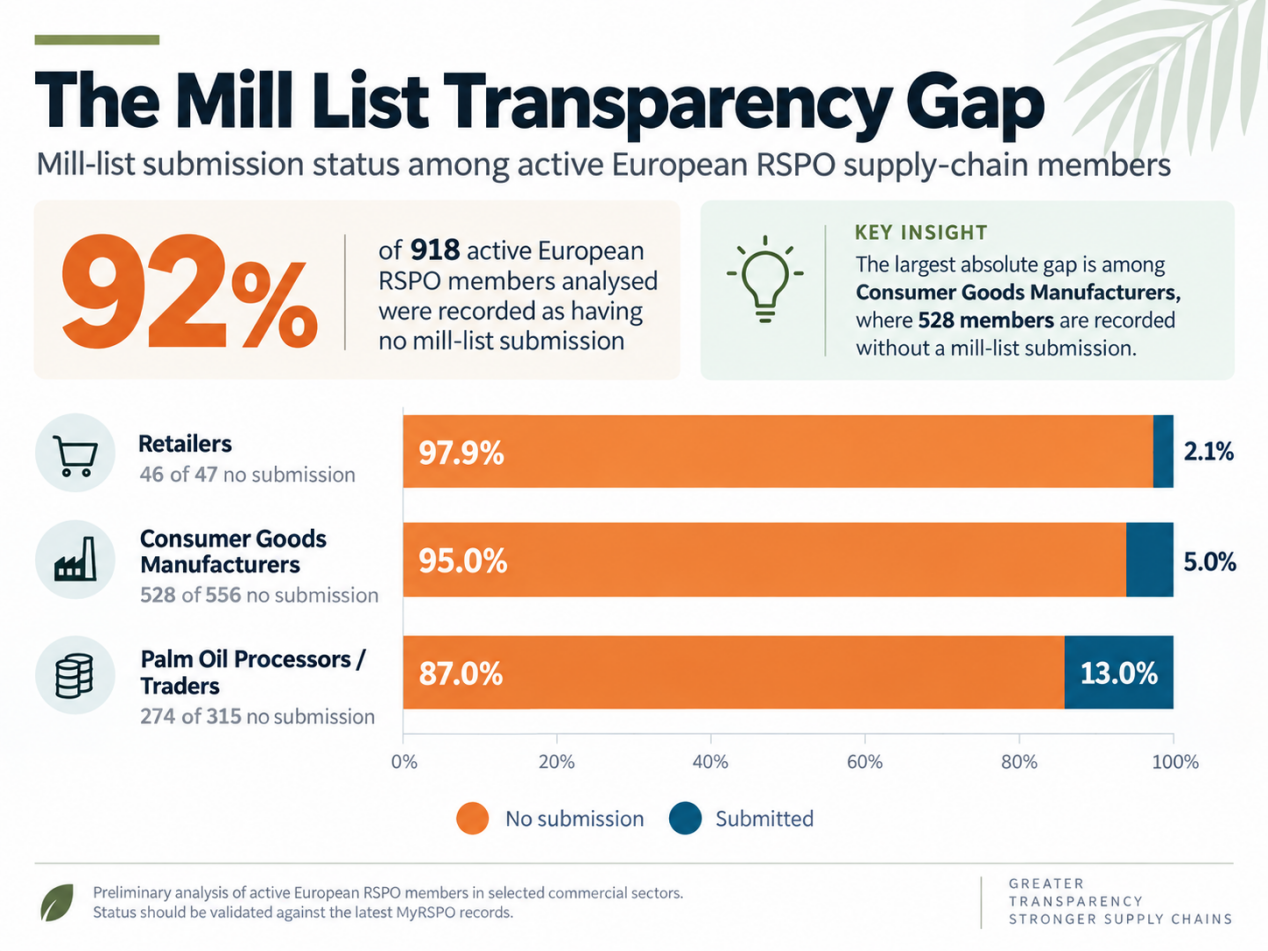
An analysis by MosaiX and Inovasi Digital of the available RSPO ACOP membership dataset examined 918 active European members across three commercially significant groups: palm oil processors and traders, consumer-goods manufacturers, and retailers. Of those companies, 848—approximately 92 percent—were recorded as having “No Submission” for their mill list in the dataset analyzed. Among processors and traders alone, 274 of 315 active European members were recorded without a submission.

The figures require caution. They represent a snapshot of the dataset rather than a formal determination of compliance, and individual records should be checked against the most recent information held by RSPO. “No Submission” can also reflect differences in reporting periods, updates, or administrative circumstances. The analysis should therefore be read as an indication of a possible transparency gap rather than a judgment on individual companies.

Even with that qualification, however, the scale of the apparent gap raises an important question. If European companies struggle to identify the mills behind their palm oil today, how easily can they make the much deeper journey toward the plantation tomorrow?

That question has become more urgent because Europe’s regulatory landscape has changed dramatically since RSPO adopted its mill-list resolution in 2018. Under the EU Deforestation Regulation, or EUDR, oil palm is one of the commodities covered by a new system of mandatory due diligence. Relevant products entering or leaving the EU market must meet deforestation-free and legality requirements. The regulation uses 31 December 2020 as its deforestation cut-off date and introduces geographic traceability to the land where covered commodities were produced. For plots larger than four hectares for relevant commodities other than cattle, the regulation’s geolocation definition provides for polygons describing the perimeter of the production plot.

Following amendments to the regulation, the main obligations are scheduled to apply to large and medium-sized operators from 30 December 2026, while most micro and small operators follow from 30 June 2027. That places European palm-oil supply chains at an unusual moment: a transparency principle developed largely through voluntary sustainability initiatives is now meeting a regulatory system built around evidence, geolocation, and due diligence.

RSPO certification and EUDR should not be confused. Neither RSPO membership nor a published mill list automatically proves EUDR compliance. The European Commission’s guidance is explicit that certification systems may support risk assessment and information gathering, but operators remain responsible for ensuring that the full requirements of the regulation are met. Among other things, EUDR traceability reaches beyond mills to the plots of land where the commodity was produced. Supply-chain models that allow material of known and unknown origin to be mixed cannot simply substitute for the traceability information required under the regulation.

Yet the two systems increasingly intersect. A credible mill list can form a bridge between a company’s commercial purchasing records and the landscapes from which its palm oil originates. Once mills are identified, supplier relationships can be organized around them. Mill identities and coordinates can be checked. Parent-company ownership can be established. Sourcing areas can begin to be mapped. Plantation polygons and smallholder origins can then be connected progressively to the mill. Satellite monitoring can be applied to those production areas, while deforestation, peat, fire, legality, and social risks can be assessed more systematically.

In this way, the mill list stops looking like an administrative spreadsheet and begins to resemble something more important: the first layer of supply-chain infrastructure.

That infrastructure also connects several generations of sustainable palm oil practices. RSPO provides certification, standards, and a multistakeholder framework. NDPE commitments extend corporate responsibility across deforestation, peat, and exploitation risks. HCV and HCS approaches help distinguish areas that should be protected. Supply-chain certification and systems such as PalmTrace help follow certified material through processing and trade. Satellite monitoring increasingly makes it possible to observe land-use change from space. Grievance and supplier-engagement processes create mechanisms for responding when problems are identified. Smallholder programs seek to ensure that increasingly sophisticated traceability systems do not simply exclude farmers who lack technology or documentation. Together, these measures reflect an industry that is gradually moving from asking whether palm oil is “sustainable” toward asking whether its environmental and social claims can actually be demonstrated.

The EUDR accelerates that evolution. It brings a regulatory demand for traceability into a sector that has already spent years building voluntary systems for certification, transparency, and responsible sourcing. Rather than treating RSPO, NDPE, and EUDR as competing frameworks, there is an opportunity to see them as different layers of the same journey. Certification establishes production and supply-chain standards. NDPE adds broader expectations for companies and suppliers. Regulation creates legally defined market requirements. The common currency among all three is increasingly credible data about origin.

This is also why the apparent European mill-list gap should not be viewed only as a problem of reporting. For some downstream companies, identifying mills is genuinely difficult. A European manufacturer may purchase an emulsifier or a specialty ingredient rather than crude palm oil. Its immediate supplier may purchase from another manufacturer, which in turn buys from several refiners. One refinery can receive material linked to many mills, and mill names themselves may appear differently across datasets because of abbreviations, subsidiaries, acquisitions, or ownership changes. Coordinates can be missing or inaccurate. The same mill can appear several times under slightly different names. A list assembled from multiple suppliers can rapidly grow into hundreds or even thousands of records.

These are not reasons to abandon transparency. They are reasons to make it easier.

There is an opportunity for RSPO and its members to treat the gap as a collective implementation challenge. Rather than simply reminding companies that mill lists are expected, a collaborative support mechanism could help downstream members turn fragmented supplier information into reliable, standardised, and regularly updated datasets. Mill identities could be matched against reference databases, coordinates validated, duplicate facilities resolved, and parent-company relationships checked. Where suppliers cannot immediately provide complete information, engagement could focus on progressively improving traceability rather than creating a simple pass-or-fail exercise.

Such support could also create a natural pathway beyond the mill. Once a company has a reliable picture of its supplying mills, the same information architecture can support plantation mapping, EUDR geolocation requirements, deforestation screening, NDPE monitoring, monitoring and wider climate and nature risk assessments. What begins as fulfilling an existing RSPO transparency commitment can therefore become a practical entry point into much more sophisticated responsible-sourcing systems.

This is where organisations operating on both sides of the supply chain may have a useful role to play. MosaiX and Inovasi Digital combine proximity to European companies with extensive experience working with palm-oil mills, corporate groups, geospatial information and production landscapes in Southeast Asia. In a potential collaboration with RSPO, that capability could be used not to create another sustainability standard, but to help members implement an existing one more effectively — connecting supplier data held in European offices with the physical mills and landscapes from which palm oil originates.

The most useful outcome would not simply be a higher number of spreadsheets uploaded to MyRSPO. It would be a stronger information bridge running from consumer markets back toward production landscapes: from a European buyer to its supplier, from the supplier to a refinery, from the refinery to its mills, and eventually from those mills to plantations and smallholders.

Twenty years ago, much of the sustainable palm oil debate centred on whether environmental and social standards could coexist with a global commodity industry. Today, the question is increasingly about evidence. Where did this material come from? Which mill processed it? Which land produced it? Was forest cleared? Was peat converted? Were people’s rights respected? And can a company demonstrate the answers rather than simply state them?

RSPO helped place transparency at the centre of sustainable palm oil long before these questions became regulatory requirements in Europe. The apparent gap in mill-list disclosure suggests that the principle is established, but the practical work of making entire supply chains visible is far from finished.

Closing that gap could therefore mean more than improving compliance with an RSPO reporting requirement. It could provide thousands of downstream companies with the first reliable coordinates on a much longer journey — one that leads from the factory floor and supermarket shelf in Europe all the way back to the forests, farms, communities and mills where the palm oil story begins.

And in an era of EUDR, NDPE and increasingly evidence-based sustainability, knowing that journey may become as important as the commodity itself.

References

  1. RSPO — Mill List Submission.Current RSPO information on GA15-6b, mill-list requirements and submission periods. RSPO Mill List Submission
  2. RSPO — Resolution GA15-6b (2018): Requiring members involved in primary procurement to publish third-party supplying mills lists.The original resolution explains the rationale for public mill disclosure and supply-chain scrutiny. RSPO Resolution GA15-6b
  3. RSPO — Mill List Submission in MyRSPO.Explains the required information, including mill name, country, GPS coordinates and parent company, and the publication of submissions through RSPO member profiles. Mill List Submission in MyRSPO
  4. RSPO — Frequently Asked Questions on Mill List Submission.Clarifies requirements for indirect buyers, Supply Chain Associates, manufacturers and retailers, and addresses implementation and certification implications.
  5. RSPO — Guide on Mill List Submission.Provides the operational process for submitting mill lists through MyRSPO and confirms that lists may be uploaded as a file or URL.
  6. European Commission — Regulation on Deforestation-free Products.Official overview of EUDR objectives, commodities covered and current implementation dates. European Commission: EUDR
  7. European Union — Regulation (EU) 2023/1115, consolidated text.Official legal text covering due diligence, geolocation and requirements for deforestation-free commodities and products. EUR-Lex: Regulation EU 2023/1115
  8. European Commission, 13 July 2026 — Commission updates product scope and tools to support EUDR.Confirms the current application dates of 30 December 2026 and 30 June 2027 and provides updated implementation context. European Commission EUDR Update, July 2026
  9. MosaiX & Inovasi Digital preliminary analysis, September 2026.Analysis of the supplied RSPO membership dataset covering active European members, membership sectors and recorded Mill List Submission status. This should be treated as a preliminary analytical dataset rather than an official RSPO compliance determination.

Practical Strategies for Indonesian Coffee and Cocoa Businesses to Comply with EUDR and Maintain Access to the EU Market

The EU Deforestation Regulation (EUDR) is changing how coffee and cocoa supply chains need to prepare for market access. For Indonesian businesses, the challenge is no longer only about understanding the regulation, but also about ensuring that the data, documentation, and traceability systems behind their supply chains are ready to support due diligence in practice.

Under EUDR, products entering the EU market must be deforestation-free, legally produced, and traceable to the plot or land level. In practice, this creates significant challenges for exporters, cooperatives, traders, and processors, particularly in smallholder-based supply chains.

This webinar was organized to provide a practical introduction to what EUDR means for Indonesian coffee and cocoa businesses, and to highlight the practical preparation that is now becoming necessary.

For those who missed the session, or for those who would like to revisit the discussion, we are pleased to share the webinar recording below.

[https://drive.google.com/file/d/1k–GXGqVA7AOgeiBrrCZIRkBJ4dhpJKF/preview]

Presented by: Ihwan Rafina, Founder and Director of MosaiX; Jeremy Nathaniel, Founder of Kopi Fabriek; Maria Benedikta, Sustainability Head of Barry Callebaut Indonesia; Caesar Argo, Thematic & Traceability Data Unit Manager of Inovasi Digital

Assisting Suppliers Readiness for EUDR Implementation with Inovasi Agriplot Due Diligence System

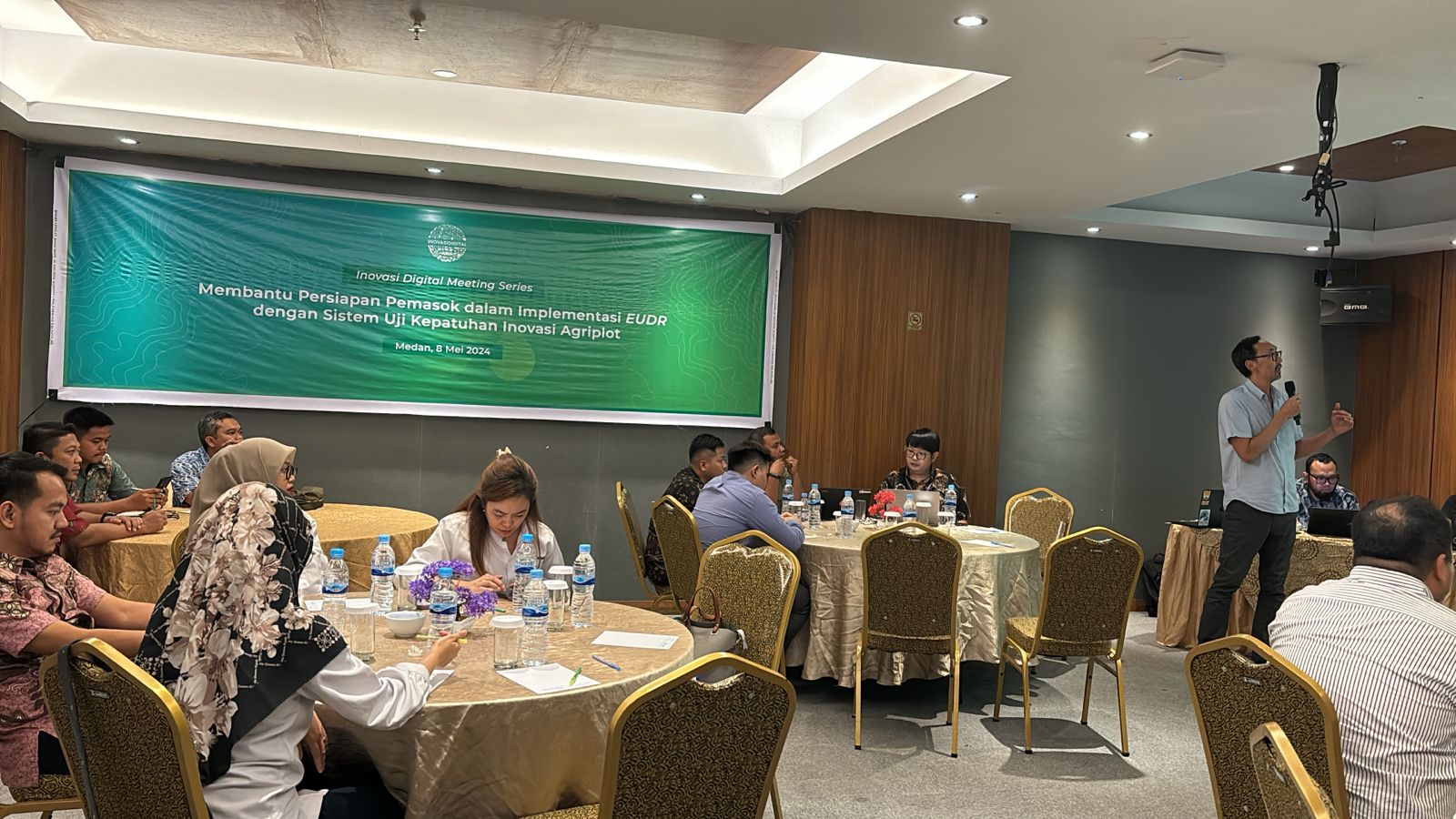
The implementation of the EU Deforestation-Free Regulation (EUDR) is fast approaching, requiring operators and traders who wish to market their goods in the European Union to understand and prepare for its requirements. ADM, as one of Inovasi Digital’s partners, markets products to the European market. Therefore, ADM and its suppliers need to comprehend the EUDR requirements. This necessity led to Inovasi Digital’s training for ADM’s suppliers, where EUDR and Inovasi Agriplot, a solution for EUDR compliance, were introduced.

On May 8, 2024, Inovasi Digital held a meeting with ADM suppliers titled “Assisting Supplier Readiness for EUDR Implementation with Inovasi Agriplot Due Diligence System” in Medan, Indonesia. During this event, Inovasi Digital provided suppliers with an introduction to EUDR, outlined the requirements for EUDR compliance, and explained Inovasi Agriplot, a turnkey solution for EUDR assessment and compliance. The objective was to support ADM’s suppliers in preparing for EUDR compliance later this year.

In this meeting, suppliers—including growers, mills, and palm oil dealers—received a presentation on EUDR, covering the history of the regulation, key requirements, and challenges. The goal was to help suppliers understand the real challenges ahead and prepare to meet the requirements. Next, the audience was introduced to the Inovasi Agriplot Due Diligence System, a solution created by Inovasi Digital to address all EUDR requirements for both operators and traders. By introducing the Inovasi Agriplot DDS, ADM suppliers can learn how to ensure a smooth transition to using the system.

The Inovasi Agriplot Due Diligence System is a comprehensive solution for those seeking to market their goods to the EU. It covers all aspects required by the EUDR in a single product. Currently, the Inovasi Agriplot Due Diligence System fully supports palm oil and is expanding to other commodities covered by the EUDR.

With the Inovasi Agriplot Due Diligence System, you will receive:

  • Traceability through Map and Supplier Information Requirements
  • Forest Cover and Deforestation Compliance Assessment
  • Legal Compliance Assessment to National Laws
  • Risk Assessment at the District Level for Land Plots
  • Risk Mitigation Plan Development and Advice

Positioned with a unique combination of spatial data, big data processing, and on-the-ground knowledge, Inovasi Agriplot is the most accurate and trustworthy platform for meeting all operators’ EUDR needs, from tracing their supply base to completing DDS requirements to risk assessments and effective mitigation approaches.